These last two articles came back to the question of whether renewable energy is worth the money and whether it could create or destroy more jobs. The concept that renewable energy is more expensive than conventional energy sources is no longer the average perspective. Though making this conversion can be difficult when US citizens have to make small conversions themselves, when done on a larger scale, it can be a much easier transition. The authors of Renewable Energybelieve that if we use renewable energy sources for the main power grids, the average citizen can save a substantial amount without having to use up their entire savings in conversion. According to Renewable Energy, this transition would be made easier by using natural gas as a backup for intermittent renewable energy sources and allow us to utilize a higher amount of renewable resources sooner rather than later.
They Took Our Jobs!
As far as new jobs are concerned, renewable energy could produce as many, if not more jobs than conventional energy. The text of Renewable Energy states that if the electric companies were no longer a protected monopoly but instead involved in a competitive market, more and more companies would start sprouting up around the country. The more of these major business that open, the more job opportunities there will be. With proper training from local educational facilities, former employees of the fossil fuel industry may be able to find employment in these new companies. The transition can be sped up considerably, but will still take some time. If workers are willing to recognize the inevitable switch from fossil fuels now, they should be prepared to continue into the changing market in the future.
Helping Our Environment
The environmental changes we could make by eliminating fossil-fuel energy production are astounding. According to Renewable Energy, if we switch to renewable energy sources, by 2050, CO2 levels could be 75% of what they were in 1985. The video to the left explains a little more about our carbon footprint.
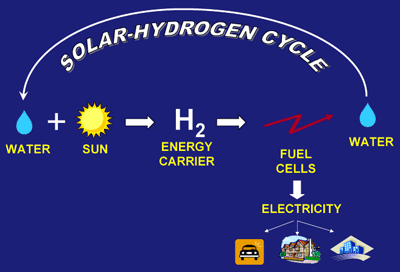
Not all renewable energy has to come from the most obvious sources either. Fuel cells that were made for the space program utilize hydrogen fuel. The authors of Renewable Energy state that the oil and natural gas companies could become the major marketers of liquid and gaseous fuels. The image to the right shows how the hydrogen cycle works for energy production
Overspending
Environment America states that An approximated 7% of America’s GDP is spent on fossil fuels. $360 billion was spent importing fossil fuels into the US in 2007. With numbers like that, it’s hard not to start looking for a change. Stabilizing the energy prices worldwide and allowing a competitive market are two factors that could begin to lower the fluctuation rates and the overall price of fuel. Because the energy production industry is a competitive market, the authors of Renewable Energy led me to believe that the US would actually spend less converting to renewable energy sources than it current does importing fossil fuels.
What Are Our Next Steps
At this point, I have a few major questions: What is our government currently doing to make this transition into utilizing renewable energy? How much energy do we currently produce using renewable resources? How can we help to speed the process along?
Resources:
Johansson, Thomas B., Henry Kelly, Amulya Reddy, Robert Williams, Laurie Burnham. Renewable Energy: Sources for Fuels and Electricity. Island Press. (1993). Google Scholar. Web. 14 April 2017
One statement of yours that I found interesting was the comment regarding the transition from fossil fuels to renewable sources, and the willingness of workers in the fossil fuel industry to accept the change. I think we've seen recently, more than ever, a resistance to change among the workers in the fossil fuel industry, and in particular, the coal industry. These folks are clinging to the possibility that coal will still be used going forward, when all economic indicators are that it wont be. We dont even have to bring renewable resources into the conversation at this point. The cost, relative cleanliness, and ease with which natural gas can be produced has made coal obsolete, and these workers still refuse to believe it. It seems like there will be an uphill battle convincing this sector of workers that their jobs may be lost, and in the end it will inevitably lead to a drawn out conversion process to renewable fuels. I am left with some questions regarding America's spending on fossil fuels. Your last figures are from 2007, and I can imagine that those nmbers have changed significantly since then. Petroleum has been pretty cheap for several years now. Cheap enough that we have significantly slowed down production of oil in our own country, and instead are importing cheap foreign fossil fuels. Given our increased production in natural gas in recent years, I'd be curious to see if the spending as a percentage of GDP has increased or decreased since 2007. I agree that an important question going forward is how can we expedite the process of change to renewable fuels. The quicker it can be done, the better as far as I'm concerned.
Samuel, Great post! I think you’ve done a great job with your blog. All of your sources were relevant and you summarized them in a way that helped the reader understand the issue and develop their own opinion. Personally, I think we should start making the switch to renewable energy as quickly as possible. I also think that it needs to be pushed by the government. It’s obvious that too many people refuse to acknowledge this need for us to make these decisions on our own. As you stated, making the switch to renewable energy is not only better for the environment, but for our economy. Going green really is the future for America, we just need to make the jump. As for your questions about what is currently being done in our government to utilize renewable energy, I think the answer is not enough. We had taken small steps forward, but this issue is no longer of importance for our government. I do think that the universal language is money, and once we can all start acknowledging that making the switch to renewable energy will make us more of it, then we will make the change. Once again, great posts. I’ve really enjoyed reading your blog.
Hey Sam I think that it is kind of crazy that the US has spent over $360 billion dollars on fossil fuels. I think it would be really cool to see a change that could potentially create more jobs. This leads me to question if there was a way we could speed up the conversion process? I would have to agree with that renewable energy is definitely worth the money.
Synthesizing Common Ground When comparing the two articles by Vanessa Brown Calder and BobbyMagill to each other, they seem to have a similar standpoint on the electric car issue. According to the NationalReview article, Tesla electric car company is only showing the positive side of their vehicle’s environmental impact. The Climate Central article uses the Nissan leaf to make the same point. The major conclusion that both authors agree upon is that the use of fossil fuels to create the electricity for these vehicles produces more carbon emissions that conventional, gas-burning vehicles. Magill does state that if the electricity was derived from wind or solar sources, it could cut down pollution by as much as 50%. Calder, in contrast, seems to acknowledge the pros of development in electric cars, but seems to focus on government spending and environmental impacts of electric vehicles currently. One discrepancy that bothers me is Calder stating that electric vehicle emissions ar...
Helping or Hindering the Workforce? In the first article , the authors express that renewable energy has a positive impact not only for the environment but for employment rates. Fuel energy has been declining in the fossil-fuel industry with little contribution from environmental regulations. Jobs in the fossil-fuel industry are primarily in operations and maintenance and jobs in manufacturing and construction are the primary focus in the renewable energy industry. The authors of the first article believe renewable energy has proven to create more jobs overall than fossil-fuel based industries. The coal industry generates only 3.96 person-years of employment, the solar industry generates 5.65, and the wind-energy industry generates 5.7. I believe these industries will prove themselves to create an even higher number of new jobs as more companies begin converting to renewable energy sources. The new jobs being created by renewable energy industries are predominate i...
Introduction Does converting to renewable fuel resources run the risk of eliminating jobs in the US? This is the question that seems to present an ongoing dispute amongst our society. It is hard to know for sure which side to lean towards. Most people seem to want to help the environment but some find the steps less realistic than others. How much would it really cost to transition from fossil fuels to renewable energy? Though this question may seem like a simple analysis of numbers, the factors that come into the equation are vast. We must break this down into more specific questions: How much money does the transition of a combustion engine into an electric or compression engine cost? What impact does utilization of electric or compression engines have on the environment and what is the most cost-effective way to generate this energy source? Another question to consider is: what non-renewables resources are being used to produce energy today? The standard cho...
 Not all renewable energy has to come from the most obvious sources either. Fuel cells that were made for the space program utilize hydrogen fuel. The authors of Renewable Energy state that the oil and natural gas companies could become the major marketers of liquid and gaseous fuels. The image to the right shows how the hydrogen cycle works for energy production


One statement of yours that I found interesting was the comment regarding the transition from fossil fuels to renewable sources, and the willingness of workers in the fossil fuel industry to accept the change. I think we've seen recently, more than ever, a resistance to change among the workers in the fossil fuel industry, and in particular, the coal industry. These folks are clinging to the possibility that coal will still be used going forward, when all economic indicators are that it wont be. We dont even have to bring renewable resources into the conversation at this point. The cost, relative cleanliness, and ease with which natural gas can be produced has made coal obsolete, and these workers still refuse to believe it. It seems like there will be an uphill battle convincing this sector of workers that their jobs may be lost, and in the end it will inevitably lead to a drawn out conversion process to renewable fuels. I am left with some questions regarding America's spending on fossil fuels. Your last figures are from 2007, and I can imagine that those nmbers have changed significantly since then. Petroleum has been pretty cheap for several years now. Cheap enough that we have significantly slowed down production of oil in our own country, and instead are importing cheap foreign fossil fuels. Given our increased production in natural gas in recent years, I'd be curious to see if the spending as a percentage of GDP has increased or decreased since 2007. I agree that an important question going forward is how can we expedite the process of change to renewable fuels. The quicker it can be done, the better as far as I'm concerned.
ReplyDeleteSamuel,
ReplyDeleteGreat post! I think you’ve done a great job with your blog. All of your sources were relevant and you summarized them in a way that helped the reader understand the issue and develop their own opinion. Personally, I think we should start making the switch to renewable energy as quickly as possible. I also think that it needs to be pushed by the government. It’s obvious that too many people refuse to acknowledge this need for us to make these decisions on our own. As you stated, making the switch to renewable energy is not only better for the environment, but for our economy. Going green really is the future for America, we just need to make the jump. As for your questions about what is currently being done in our government to utilize renewable energy, I think the answer is not enough. We had taken small steps forward, but this issue is no longer of importance for our government. I do think that the universal language is money, and once we can all start acknowledging that making the switch to renewable energy will make us more of it, then we will make the change. Once again, great posts. I’ve really enjoyed reading your blog.
Hey Sam I think that it is kind of crazy that the US has spent over $360 billion dollars on fossil fuels. I think it would be really cool to see a change that could potentially create more jobs. This leads me to question if there was a way we could speed up the conversion process? I would have to agree with that renewable energy is definitely worth the money.
ReplyDelete